Kartra Vs. Kajabi: Which All-in-One Solution Reigns Supreme?
Starting your online business requires the right tools. Among the many available, Kartra and Kajabi stand out for their holistic approach. These SaaS platforms help you build websites, market your products, and provide customer support from a single dashboard.
Kartra lets you sell both digital and physical products, making it versatile. On the other hand, Kajabi focuses on digital content and online courses. This makes it ideal for entrepreneurs in the education sector.
Both platforms offer powerful features, but their key difference lies in their target market. Kartra is better for those wanting to sell a variety of products, while Kajabi excels in delivering and managing digital courses.
This review will focus on their digital sales capabilities to help you decide which platform is best for selling your courses. Let’s look at the advantages and benefits of Kartra vs. Kajabi.
Pros and Cons of Kartra
Pros:
Cons:
Pros and Cons of Kajabi
Pros:
Cons:
Comparison Table for Kartra Vs. Kajabi:
Here’s a comparison table for Kartra vs. Kajabi:
| Features | Kartra | Kajabi |
|---|---|---|
| Primary Focus | All-in-one marketing platform | All-in-one online course creation platform |
| Website Builder | Yes, includes templates and drag-and-drop | Yes, includes templates and drag-and-drop |
| Sales Funnels | Yes, advanced funnel-building capabilities | Yes, basic funnel capabilities |
| Email Marketing | Yes, advanced with automation | Yes, integrated with automation |
| Membership Sites | Yes, robust membership site creation | Yes, robust membership site creation |
| Course Creation | Yes, but less specialized | Yes, highly specialized |
| Affiliate Management | Yes, built-in affiliate management | Yes, built-in affiliate management |
| Integrations | Many third-party integrations | Limited third-party integrations |
| CRM | Yes, integrated CRM | Basic CRM features |
| E-commerce | Yes, includes a shopping cart and upsells | Yes, includes a shopping cart and upsells |
| Analytics | Yes, detailed analytics and reporting | Yes, detailed analytics and reporting |
| Pricing | Starts at $99/month | Starts at $119/month |
| Support | 24/7 support through email and chat | 24/7 support through email and chat |
| Ease of Use | Steeper learning curve due to features | User-friendly, designed for beginners |
What is the Difference Between Kajabi and Kartra?
Choosing the right platform for your online business can be challenging. Kajabi and Kartra are two popular options, each offering a range of features to help you manage and grow your business. In this detailed comparison, we’ll explore various aspects of both platforms to help you decide which one suits your needs best.
1. Pricing Plans
Kajabi offers four main pricing tiers:
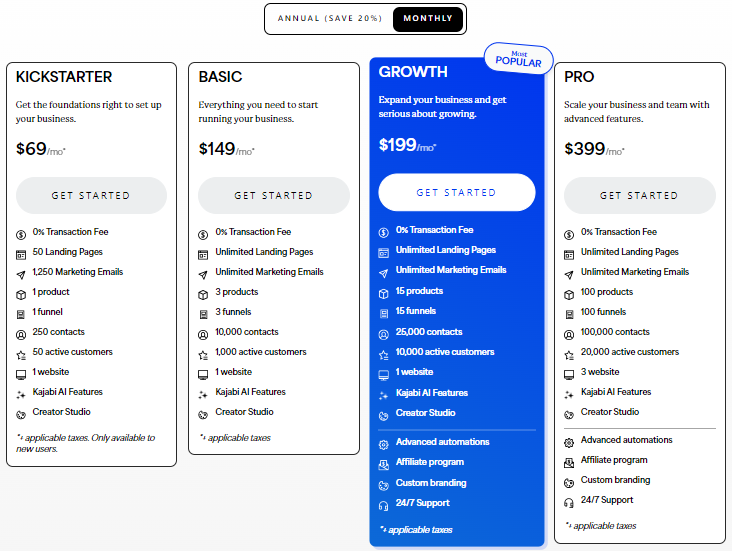
KICKSTARTER – The Kickstarter plan is $69 per month and includes 50 Landing Pages, 1,250 Marketing Emails, 1 Product, 1 Funnel, 250 Contacts, 50 Active Customers and 1 website.
BASIC – The Silver plan costs $149 per month and offers Unlimited Landing Pages, Unlimited Marketing Emails, 3 Products, 3 Funnel, 10,000 Contacts, 1,000 Active Customers, and 1 website.
GROWTH – The Gold plan is priced at $199 per month and includes Unlimited Landing Pages, Unlimited Marketing Emails, 15 Products, 15 Funnel, 25,000 Contacts, 10,000 Active Customers, and 1 website.
PRO – The Pro plan is priced at $399 per month and includes Unlimited Landing Pages, Unlimited Marketing Emails, 100 Products, 100 Funnel, 100,000 Contacts, 20,000 Active Customers, and 3 websites.
Kartra also has three primary pricing plans:
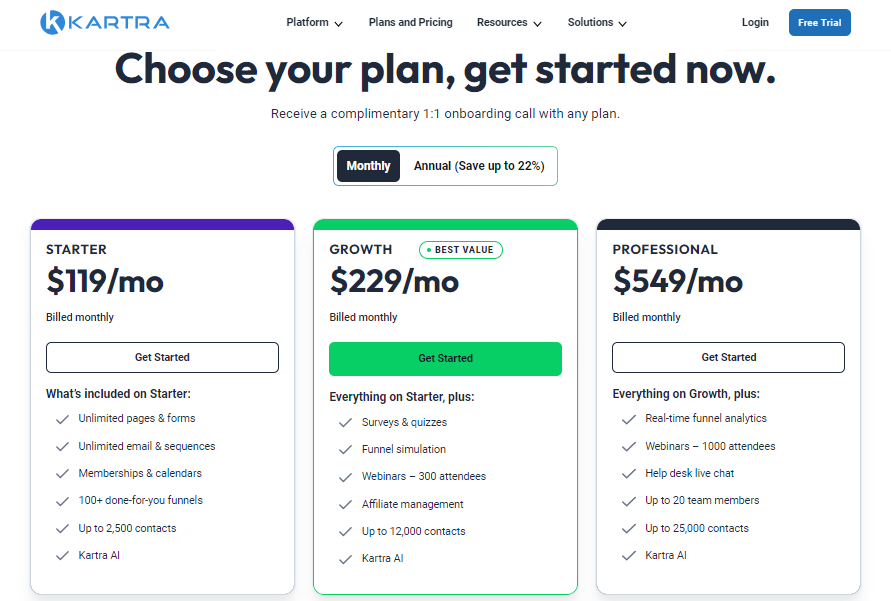
Basic – The Basic plan starts at $119 per month and includes 1 domain, 5 team members, and 2,500 contacts.
Growth – The Growth plan costs $299 per month, offering 3 domains, 10 team members, and 12,500 contacts.
Professional – The Pro plan, priced at $549 per month, allows for 5 domains, 20 team members, and 25,000 contacts.
All plans come with unlimited landing pages, marketing emails, and 1 website.
2. Creating Courses
Kajabi excels in course creation. It provides a user-friendly interface to build, market, and sell online courses. You can easily upload videos, create quizzes, and add downloadable content. The platform supports multiple content types, including audio, video, and text.
Kartra also supports course creation but focuses more on the sales and marketing aspects. While you can create courses with Kartra, it doesn’t offer the same level of detail and customization as Kajabi. Kartra’s strength lies in integrating your course with marketing campaigns.
3. Landing Pages
Kajabi offers a variety of templates to create visually appealing landing pages. Its drag-and-drop builder makes it easy to customize these templates to suit your brand. You can add videos, forms, and countdown timers to enhance engagement.
Kartra provides robust landing page capabilities. It features a drag-and-drop editor, extensive templates, and A/B testing options. Kartra’s landing pages are designed for high conversions, with built-in analytics to track performance.
4. Membership Sites & Communities
Kajabi is ideal for building membership sites and communities. It allows you to create exclusive content for members, manage subscriptions, and engage with your community through forums and comments. Kajabi’s membership features are well-integrated with its course creation tools.
Kartra also supports membership sites but focuses more on sales and marketing automation. You can create different membership tiers, drip-feed content, and manage access levels. Kartra’s membership capabilities are robust but not as community-focused as Kajabi’s.
5. Mobile App
Kajabi offers a mobile app that lets your users access content on the go. The app is available for both iOS and Android devices, providing a seamless experience for course consumption and community engagement.
Kartra does not have a dedicated mobile app. However, its web-based platform is mobile-friendly, allowing users to access content and manage their accounts from mobile devices.
6. Lead Management
Kajabi provides basic lead management features. You can capture leads through forms and landing pages and manage them within the platform. Kajabi’s lead management is straightforward but lacks advanced features like tagging and segmenting.
Kartra excels in lead management. It offers comprehensive tools to capture, tag, segment, and nurture leads. Kartra’s lead scoring system helps you identify and focus on high-quality leads, making it a powerful tool for sales and marketing.
7. Sales Management
Kajabi offers basic sales management features. You can create offers, set pricing, and manage transactions. Kajabi integrates with popular payment gateways like Stripe and PayPal, making it easy to process payments.
Kartra provides advanced sales management tools. You can create detailed sales pipelines, track conversions, and manage affiliates. Kartra’s built-in CRM helps you manage customer relationships and sales processes efficiently.
8. Funnels and Campaigns
Kajabi offers pipelines, which are essentially sales funnels. You can create automated marketing campaigns using pre-built templates. These pipelines guide your leads through a series of steps, from awareness to purchase.
Kartra is renowned for its funnel and campaign capabilities. It offers a wide range of pre-designed funnels for various business goals. Kartra’s drag-and-drop builder allows you to customize these funnels, and its automation features help you create complex marketing campaigns.
9. Analytics
Kajabi provides detailed analytics to track your course performance, sales, and marketing efforts. You can monitor student progress, sales trends, and email campaign success. Kajabi’s analytics help you make data-driven decisions.
Kartra offers extensive analytics and reporting tools. You can track leads, sales, email open rates, and campaign performance. Kartra’s analytics dashboard is comprehensive, providing insights into every aspect of your business.
10. Automated Sequences
Kajabi allows you to create automated email sequences to nurture leads and engage with customers. You can set up triggers based on user actions, such as completing a course or making a purchase.
Kartra excels in automation. Its “Kartra Sequences” feature lets you create intricate automation workflows. You can set up conditional logic, triggers, and actions to automate your marketing and sales processes seamlessly.
11. Email Marketing
Kajabi includes email marketing tools to create, send, and track emails. You can design emails using templates and segment your audience for targeted campaigns. Kajabi’s email marketing is straightforward but lacks advanced features.
Kartra offers robust email marketing capabilities. You can create complex email sequences, segment your audience, and track performance. Kartra’s email editor includes A/B testing and advanced automation features, making it a powerful tool for email marketing.
12. Sales Funnels
Kajabi provides pre-built sales funnel templates called pipelines. These templates help you create marketing campaigns that guide leads through the sales process. Kajabi’s pipelines are easy to set up and customize.
Kartra is designed for sales funnels. It offers a variety of funnel templates for different business goals. Kartra’s drag-and-drop editor allows you to create and customize funnels easily. Its advanced features include upsells, downsells, and order bumps.
13. Affiliate Marketing
Kajabi includes basic affiliate marketing tools. You can create affiliate programs, manage affiliates, and track commissions. Kajabi’s affiliate features are simple but effective for small programs.
Kartra offers a complete affiliate management system. You can create detailed affiliate programs, set commission structures, and track performance. Kartra’s affiliate tools are robust, making it easy to manage large affiliate networks.
14. Webinars
Kajabi allows you to host webinars using third-party integrations like Zoom. You can promote your webinars through Kajabi’s marketing tools and capture leads with registration forms.
Kartra supports webinars through integrations with tools like WebinarJam and EverWebinar. You can create automated webinar funnels, capture leads, and follow up with attendees using Kartra’s marketing automation.
15. Customer Service
Kajabi offers 24/7 customer support through live chat, email, and a knowledge base. Its support team is known for being responsive and helpful. Kajabi also provides extensive resources, including tutorials and webinars, to help you get the most out of the platform.
Kartra provides 24/7 customer support through live chat, email, and a knowledge base. Kartra’s support team is responsive and knowledgeable. The platform also offers detailed guides, video tutorials, and a community forum for additional support.
Kartra Vs. Kajabi: Which One Is Best?
Choosing between Kartra and Kajabi depends on your specific needs. Both platforms excel in different areas. Kartra offers better website building, affiliate marketing, and email marketing tools. It’s versatile, supporting the sale of physical and digital products. It also includes a helpdesk and scheduling tool, making it ideal for service-based businesses.
On the other hand, Kajabi stands out for its ease of use in building sales funnels and courses. It’s perfect for online course providers, offering a powerful course builder and entire website management. While Kartra is a cost-effective option with a broad range of features, Kajabi justifies its higher price with specialized tools for course creation and content management.
Ultimately, the best choice depends on whether you prioritize marketing versatility or dedicated course-building capabilities. Share your experiences with these platforms in the comments below!
FAQs About Kartra Vs. Kajabi
Kartra replaces multiple tools. It covers email marketing, landing pages, membership sites, and sales funnels. Kartra also handles lead management, automation, and analytics. It replaces the need for separate platforms, saving time and money. With Kartra, you get an all-in-one solution for your online business needs.
Kajabi is not only for courses. It also supports building websites, creating membership sites, hosting podcasts, and running blogs. You can use it for email marketing and automation too. Kajabi helps manage your entire online business, not just courses. It’s a versatile platform for various digital content and marketing needs.
You can host a course on Kartra. Kartra provides tools to create, manage, and sell your online courses. You can upload your content, design course pages, set up memberships, and track student progress. It’s a complete platform for anyone looking to offer online courses.
Kajabi is good for SEO. It offers tools to optimize your website and content for search engines. With features like customizable URLs, meta tags, and image alt texts, Kajabi helps improve your site’s visibility. Additionally, it integrates well with Google Analytics, aiding in tracking and improving your SEO efforts.